




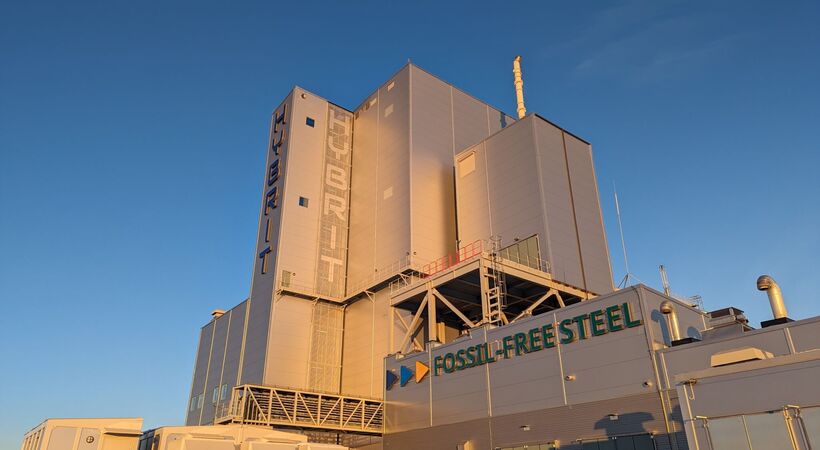
The HYBRIT initiative, a collaboration between steelmaker SSAB, miner LKAB, and energy company Vattenfall, that was launched to ‘virtually eliminate carbon dioxide emissions in the steel industry’, has presented the results of six years of research in a final report to the Swedish Energy Agency.
The report shows that direct reduced iron produced with the HYBRIT process has superior characteristics compared to iron produced with fossil fuels. HYBRIT has applied for and received several patents based on the successful results, and the project is now continuing in the next phase where the process is to be implemented on an industrial scale.
''At SSAB, we are now investing heavily to convert the entire Nordic production system to fossil-free steel production and have already started delivering fossil-free steel to customers on a smaller scale.”
Martin Pei, chief technology officer at SSAB and chairman of the board of Hybrit Development AB
“I am incredibly proud of everything HYBRIT has achieved since its launch in 2016. Thanks to the successful results of the pilot project, we are well on our way to fundamentally changing the iron and steel industry. At SSAB, we are now investing heavily to convert the entire Nordic production system to fossil-free steel production and have already started delivering fossil-free steel to customers on a smaller scale,” said Martin Pei, chief technology officer at SSAB and chairman of the board of Hybrit Development AB.
The initiative aims to decarbonize the steel industry by replacing coal and coke in the production of iron with fossil-free hydrogen and electricity. The transition from coal and blast furnace-based steelmaking to HYBRIT technology and the melting of iron in electric arc furnaces is expected to reduce Sweden's total carbon dioxide emissions by more than 10% and Finland’s by 7%.
The project is the first in the world to demonstrate that the fossil-free value chain – from iron ore to steel – works on a semi-industrial scale. So far, more than 5kt of hydrogen-reduced iron have been produced at HYBRIT's pilot plant in Luleå.
The research results now presented in a final report to the Swedish Energy Agency span from 2018 to 2024, with a focus on scaling up technical solutions from the laboratory to industrial scale, developing an industrial process practice and achieving an integrated value chain for hydrogen-based iron and steelmaking.
Examples of results from the pilot phase are: the development of a new hydrogen-based technology for efficient fossil-free iron and steel production with 0.0 tonnes of CO2 emissions per tonne of steel, the development of a new fossil-free iron product (sponge iron) that has significantly better properties than iron reduced with fossil gases such as natural gas, the successful long-term operation of alkaline electrolysers for the production and storage of hydrogen, and the development of an efficient process practice for melting fossil-free sponge iron into crude steel in an electric arc furnace.
''The knowledge and experience we have developed during the project will now be focused on continuing the process development, primarily to support the owners´ industrialisation projects.”
Ulf Spolander, general manager of Hybrit Development AB
“The focus of HYBRIT's technical development has been to build up expertise and create technical conditions for the implementation of a fossil-free process in a full-scale production. We are very pleased that we as a team have been able to deliver successful results that have met or exceeded the set project goals. The knowledge and experience we have developed during the project will now be focused on continuing the process development, primarily to support the owners´ industrialisation projects,” said Ulf Spolander, general manager of Hybrit Development AB.
The results from the pilot phase pave the way for implementing the HYBRIT process on an industrial scale. Hybrit Development AB will continue to conduct research and development to support the industrialisation of the technology together with the owner companies, including delivering solutions to LKAB's planned demonstration plant in Gällivare. The pilot project for storing fossil-free hydrogen in Svartöberget in Luleå will continue until 2026.
