




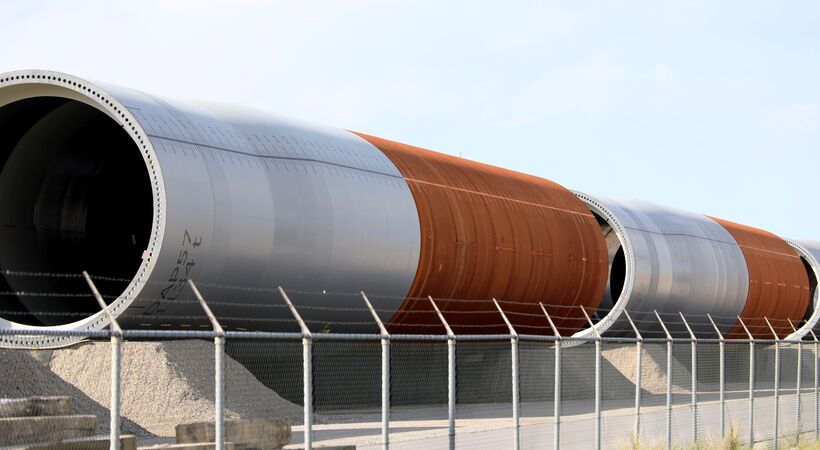
German steelmaker Dillinger has developed new steel types together with Saarland University and RWTH Aachen University.
Other partners involved in the ‘High-Performance Steel Plate (HL Steel Plate)’ research project also contributed to the project, which was funded by the German Federal Ministry for Economic Affairs and Climate Protection and recently concluded successfully after almost four years.
These new products are particularly suited for monopiles, says Dillinger — the steel towers for offshore wind turbines — and their properties enable them to withstand storms, waves, and aggressive saltwater for many years, yet they can still be produced economically. These new steels are suitable for high-energy submerged arc welding and electron beam welding, which is aimed to shorten production times for processors.
''Our special materials are suitable for industrial mass production and represent a milestone in the fabrication of heavy plates for the monopile foundation structures of offshore wind turbines.”
Dr. Sebastian Scholl, project manager, research and development department, Dillinger
“These high-performance welding processes are increasingly being used in large-scale industrial production for welding-intensive steel applications. Particularly in the case of monopiles, joints stretching for kilometres are required due to the huge size of the structures with large sheet thicknesses. Such a process requires materials that can withstand the enormous temperature influences during the joining process. Our special materials are suitable for industrial mass production and represent a milestone in the fabrication of heavy plates for the monopile foundation structures of offshore wind turbines,” explained project manager Dr. Sebastian Scholl from the research and development department at Dillinger.
The associated project partners and processors (SIF Group, EEW Special Pipe Constructions, Steelwind Nordenham, Meyer Werft, Lincoln Electric) carried out their own high-performance welding processes on the new steel materials under realistic conditions and were able to observe the results for themselves.
“The advantages of the new steel types are obvious: improved properties and cost savings thanks to shorter production times for the processing customer.''
Dr. Peter Maagh, member of the board of management for technology, Dillinger
“The advantages of the new steel types are obvious: improved properties and cost savings thanks to shorter production times for the processing customer. As a company, we can also use these products to help accelerate the expansion of renewable energies and secure the viability of production sites in Germany,” said Dr. Peter Maagh, member of the board of management for technology at Dillinger, summarizing the research results.